Jonathan Anderson’s haute couture debut for Dior proposes a new way of understanding luxury: open, emotional and deeply contemporary.
There was anticipation, recent memory and one question hanging in the air: what does haute couture mean today? With his Spring 2026 collection, Dior offers an ambitious answer. In his first couture outing for the house, Jonathan Anderson doesn’t simply present exceptional garments; he proposes an entirely new system — a cultural choreography that expands the historic couture ritual into the present. The result is a collection in constant bloom, where craftsmanship, nature and emotion become a shared language.
The setting itself suggested continuity and rupture. A familiar space — the reimagined silver tent where Anderson had shown his men’s collection days earlier — welcomed a top-tier audience. Among those in attendance were Brigitte Macron, Bernard Arnault, Jeff Bezos and Lauren Sánchez, alongside figures from cinema and fashion including Anya Taylor-Joy, Jennifer Lawrence and Greta Lee. John Galliano also returned to a Dior show for the first time since 2011, a moment heavy with symbolism. The late arrival of Rihanna heightened the tension; what followed on the runway erased any lingering doubt.


Anderson sets out to rethink the model established by Charles Frederick Worth in the 19th century. To the traditional sequence — runway show, private fittings, made-to-measure orders — he adds two new chapters: an exclusive client event and a week-long exhibition open to the public. Haute couture, he suggests, should not be a closed club, but a laboratory of ideas capable of inviting everyone in without diluting excellence.
The collection opens with bulbous, generously pleated dresses, referencing both Anderson’s first ready-to-wear gesture at the house and the sensual ceramic forms of Magdalene Odundo. That artistic collaboration extends to several Lady Dior handbags, while a selection of ceramics converses with fifteen looks from the season and archival pieces by Christian Dior himself. The notion of curation runs throughout: looking at history, intervening in it and allowing new readings to emerge.


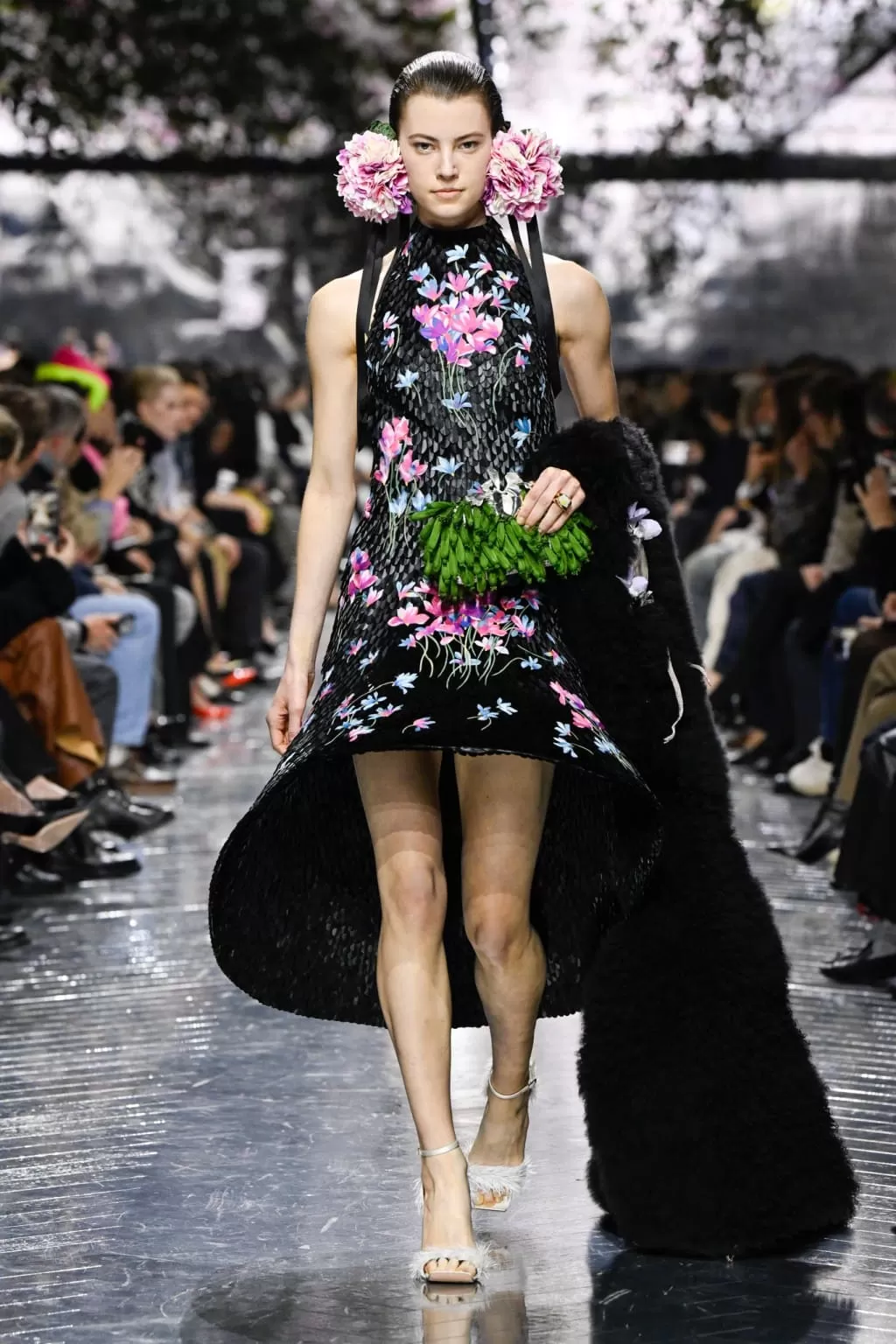


At the heart of the work lies craftsmanship. Hourglass coats and draped dresses covered in thousands of fabric petals reveal a technical mastery that seeks not to intimidate, but to move. Anderson insists on purpose: buying couture as an emotional act, not as ostentation. A new sense of lightness — sometimes absent from his red-carpet outings — is evident here. Translucent tops swirl like seashells; feathery scales evoke macro images of butterfly wings; knitted mini-capes envelop the body in softness.
Floral references are omnipresent without ever becoming literal. Bell-shaped dresses recall lily of the valley, the founder’s fetish flower, magnified into architectural forms. Dior’s “flower women” return without nostalgia, reinterpreted with humour and precision. Anderson also engages with his predecessors without falling into quotation: the sharp tailoring and surgical ornamentation of Raf Simons can be sensed in a minimalist black Bar jacket, while Galliano’s Belle Époque sensuality appears in bias-cut black gowns.
The proposal extends beyond the runway. In addition to the 63 looks shown, Anderson created a separate collection exclusively for clients and a series of accessories incorporating genuine antiques: stoles pinned with 18th-century miniatures, evening clutches lined with fabrics from the era of Marie Antoinette, and jewellery set with fossils and meteorites. Uniqueness without elitism, he argues, since the public exhibition acts as a gateway to a craft at risk.
The final gesture seals the intent: the first couture look will be donated to the Victoria and Albert Museum in London, as part of a programme designed to re-engage the public with couture. Dior Haute Couture Spring 2026 is not merely a debut; it is a statement. In Jonathan Anderson’s hands, couture truly blooms when it is shared, closely observed and allowed to begin again.