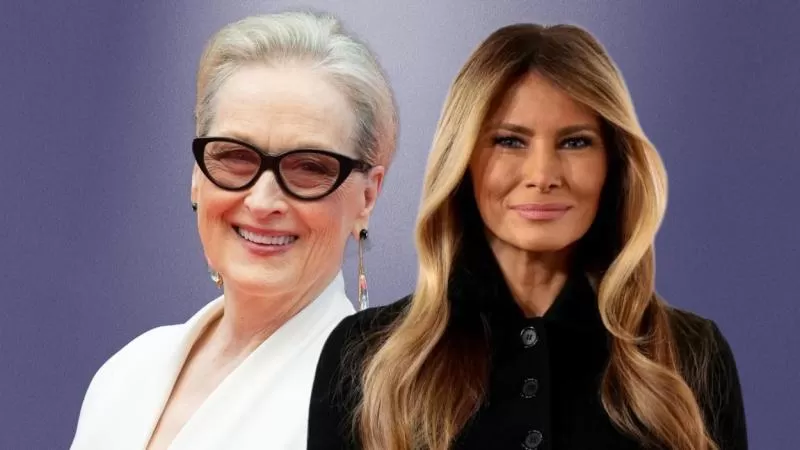

Meryl Streep criticises Melania Trump and highlights the aesthetic and political pressure placed on women in power in a Vogue interview.
While promoting ‘The Devil Wears Prada 2’, Meryl Streep moved far beyond cinema. In her conversation with Anna Wintour, the actress brought forward a direct critique of the system that shapes the image of women in positions of power — and she did so by openly referencing Melania Trump. Streep revisited one of the most uncomfortable moments in recent political history: the jacket with the message “I Really Don’t Care, Do U?” that Melania wore in 2018 during a visit to detained migrant children. She did not mention it as an anecdote, but as a symptom. “I think that coat was the clearest message she ever sent,” she said. The reading is unmistakable: fashion is not superficial, it is power. And in certain contexts, it can also operate as a form of symbolic violence.
- Aesthetic as a tool of control
From there, Streep expanded her argument. She was not speaking about a single figure, but about a broader structural pattern: the expectations placed on how women present themselves when they reach positions of influence. “I’m struck by the fact that women in power are expected to show their arms on television while men are completely covered in suits,” she noted.
This is not a minor detail. It reflects an unwritten rule shaped by a clear logic: making female power more digestible, less threatening. While men consolidate authority through the uniformity of the suit, women remain subject to codes that involve exposure, vulnerability and, in some sense, a constant need to justify their presence. Streep describes it directly as an “implicit apology”. “It’s as if they have to say, ‘I’m not dangerous,’” she added.
- When female power unsettles
The actress goes further by placing this dynamic in context. She does not frame it as an aesthetic coincidence, but as a reaction to decades of progress. “Women’s advances have been destabilising,” she explained. The choice of wording is deliberate. To destabilise is to disrupt an existing order — and in this case, that order was built on a clear hierarchy. What Streep suggests is that this discomfort still exists, even if it now operates in more subtle ways. The result is a strange balance: women access positions of power, but under conditions that continue to limit how they can inhabit them.
- Fashion, politics and contradiction
The context of this conversation is equally telling. The return of Miranda Priestly — one of the most iconic characters at the intersection of fashion, power and hierarchy — adds another layer of meaning. In ‘The Devil Wears Prada 2’, the character navigates a media landscape in crisis, where traditional structures are losing relevance. A scenario that, in many ways, mirrors what is happening beyond fiction. Streep has made it clear that what interests her is not only the story, but what it represents: what it means to hold power when the rules are shifting, yet long-standing patterns remain unchanged.
- Beyond a single statement
Although media attention has focused on Melania Trump, the scope of Streep’s comments goes much further. She is not simply criticising a wardrobe choice, but a system that continues to shape how female power is perceived and permitted. In that sense, her intervention acts as a pointed reminder: gaining access to power does not necessarily mean having freedom within it.
And as long as that tension persists, image will remain a battlefield.

-380x380.webp)