
Nicki Minaj’s political turn reopens old controversies and casts her long-standing conflict with Miley Cyrus in a new light
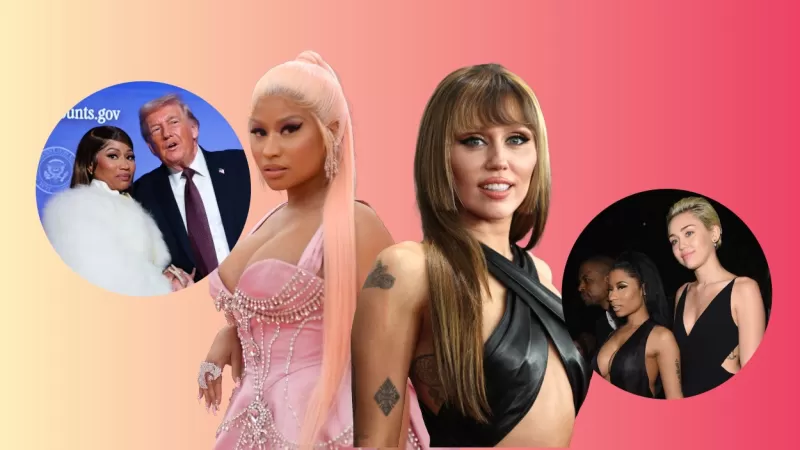
For years, the clash between Nicki Minaj and Miley Cyrus was dismissed as a typical celebrity beef: bruised egos, coded jabs and media noise. Viewed from the present, however — with Minaj showing increasingly explicit support for Donald Trump and the wider MAGA ecosystem — that conflict takes on a deeper ideological and cultural meaning.
The tension did not come out of nowhere, nor was it an isolated episode. In 2015, Miley had already been criticised for appropriating feminist and racial discourses in a superficial way, something Nicki Minaj publicly called out. Years later, in 2019, the dispute resurfaced when Cyrus referenced Nicki in a song lyric. The response came via Queen Radio, where the rapper referred to Miley as “Perdue Chicken” — a dismissive remark that reduced the singer to a mocking, deliberately humiliating caricature.
This was not an off-the-cuff comment or a red-carpet slip. It was a calculated decision, delivered from a platform where Minaj had complete control over the narrative.
Selective misogyny and power
Beyond the insult itself, what matters is the position from which it was delivered. Nicki Minaj has long claimed her place as a powerful woman in a hostile industry, yet her attack on Miley was not an exercise in structural critique, but a display of personal contempt. A way of establishing hierarchy between women: who deserves respect and who can be ridiculed.
That pattern aligns with what has since become more visible — a form of selective misogyny, where self-empowerment does not necessarily translate into solidarity or political coherence. The issue is not confrontation itself, but the direction of the blow.
The MAGA turn that reshapes the past
Nicki Minaj’s current support for Donald Trump, her public gestures of sympathy towards Trumpism and her proximity to conservative rhetoric have unsettled parts of her fanbase. At the same time, they have prompted a reassessment of past episodes that were once downplayed.
Trumpism is not merely a political stance; it is a culture rooted in confrontation, public derision and the normalisation of attack — particularly against women who embody ambiguity, sexual freedom, critical thinking or aesthetic dissent. Miley Cyrus represents all of that.
Seen from today’s perspective, Minaj’s verbal aggression towards Miley stops looking like a momentary outburst and begins to read as an early symptom of alignment with authoritarian values, where power is exercised through humiliation.
The contrast with Miley
While Minaj has gravitated towards conservative discourse and positions increasingly close to the American right, Miley Cyrus has moved in the opposite direction: critically reassessing her past, maintaining consistent support for the LGBTQ+ community and pursuing an artistic evolution less accommodating to the system.
That contrast helps explain why many now reinterpret the episode not as a pop anecdote, but as a turning point. It was not just an insult; it was a signal.
When pop stops being neutral
The Minaj–Cyrus case proves that pop culture is never neutral. Words, silences and alliances construct narratives that, over time, organise themselves.
The Nicki Minaj who today flirts with Trumpism is the same artist who, in 2019, chose to publicly ridicule another woman from a position of power. Not because she has changed, but because the current context allows us to see what was previously ignored.
And when the pieces fall into place, the story stops being uncomfortable and becomes unmistakably clear.