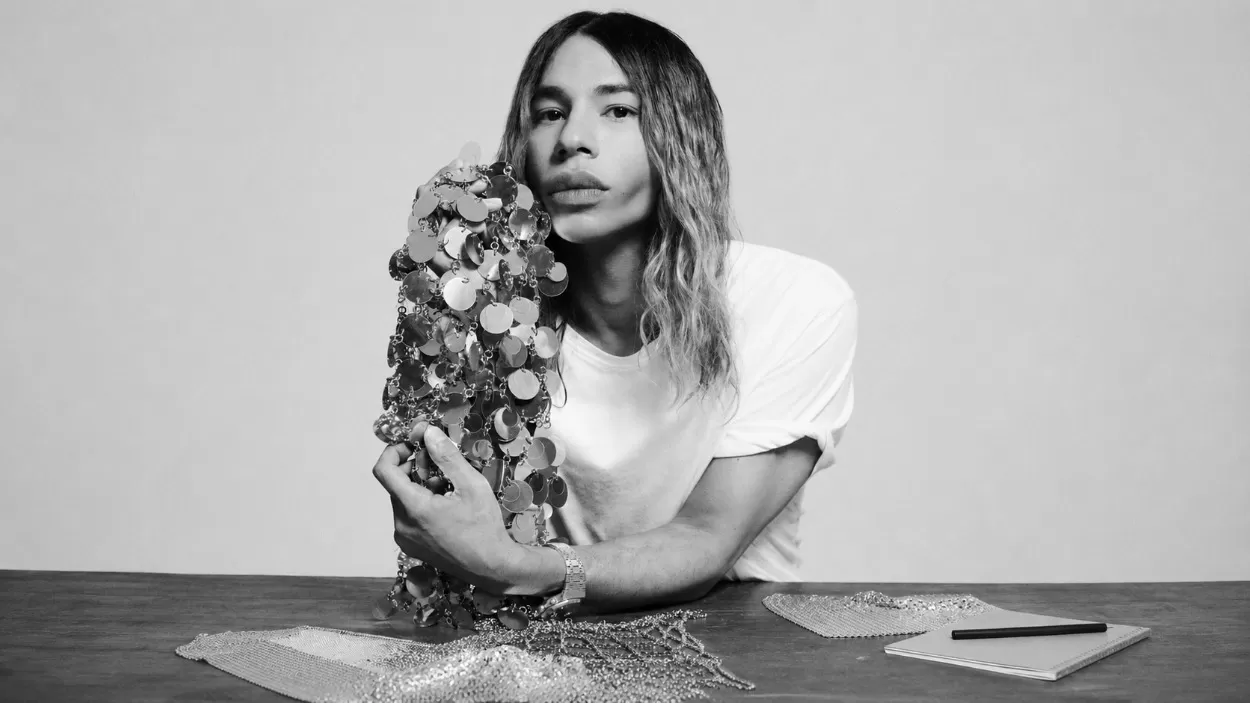

Olivier Rousteing takes over as creative director of Rabanne with an ambitious vision that brings together fashion, beauty, archives and pop culture.
Olivier Rousteing is beginning a new chapter in his career at the helm of Rabanne, one of the most recognisable houses in French fashion. After a long and defining tenure at Balmain, where he spent 16 years, 14 of them as creative director, the French designer now takes on the challenge of reinterpreting the legacy of Paco Rabanne through a contemporary, global lens deeply connected to pop culture.
The appointment marks one of the most significant moves in the industry in recent months. Rousteing officially began his role at Rabanne on 6 July and will present a pre-fall collection in November, before making his runway debut during Paris Fashion Week in March 2027. Asked about the direction he wants to take the maison in, the designer replied with a phrase that perfectly sums up his ambition: “To the moon!”
Rousteing’s connection with Paco Rabanne began long before this appointment. The creative recalls discovering the world of the Spanish designer when he was around 12 years old, watching a television documentary with his grandparents in Bordeaux. The footage showed icons such as Françoise Hardy, Brigitte Bardot and Audrey Hepburn wearing Rabanne’s metallic and futuristic designs. “I remember thinking: ‘Are these dresses or superheroes?’” he confessed. “You know how much I love superheroes.”
That fascination with visual strength, unexpected materials and the idea of a powerful woman connects directly with Olivier Rousteing’s own creative identity. The designer has built much of his career around the idea of fashion as a laboratory, a space in which to experiment with techniques, fabrics and symbols. “I always try to see fashion as a laboratory. I always try to push boundaries. I have always loved finding creativity in materials and fabrics,” he explained.
For Rousteing, Paco Rabanne’s legacy remains revolutionary because, in the 1960s and 1970s, the designer dared to imagine dresses made from metal, PVC and unconventional materials at a time when fashion was still dominated by far more traditional codes. “Paco Rabanne has always been part of my moodboard,” he acknowledged. “He was a legend as a man, as a creator known for his craftsmanship and as a couturier who truly embraced pop culture.”
The house, owned by Puig, is entering a period of consolidation following the work of Julien Dossena, who spent 13 years as creative director. Rousteing said he feels both pride and responsibility in taking over that role, while also recognising the talent of his predecessor. His arrival does not represent a complete rupture, but rather a new phase for a maison that has managed to keep its experimental spirit alive.
From Puig, Ana Trias, president of prestige and fashion brands, described Rousteing’s vision as “bold, magnetic and deeply connected to today’s energy”. She also highlighted his ability to create fashion linked to confidence, individuality and self-expression, while never losing sight of the power of the archives and the identity of an iconic house.
The new chapter at Rabanne will also seek to strengthen the dialogue between fashion and beauty. The maison has built a solid universe through successful fragrances such as 1 Million, Invictus, Black XS and Phantom, and Rousteing now wants to deepen that connection. “There will be one storyline: fashion and beauty meet. That will be my role,” said the designer, who also acknowledged his personal love of perfume.
The historic codes of Rabanne will remain fundamental: metal mesh, silver and gold discs, square chain links, futuristic shine and the idea of dressing women as though they were wearing armour. Rousteing particularly admires that protective and powerful dimension of Paco Rabanne’s legacy, seeing him as a dreamer, an outsider and a creator who never wanted to fit inside a box.
The designer arrives at this new stage after defining an era at Balmain, where he turned the house into a global phenomenon through his mastery of social media, his relationship with music, his commitment to diversity and his ability to blend luxury, spectacle and popular culture. After leaving the brand, he returned to the fashion spotlight by dressing Beyoncé for the Met Gala, an experience that, according to him, gave him renewed strength and confidence.
Now, at Rabanne, Rousteing seems to be reconnecting with the initial emotion that first led him to fashion. “The beauty of this industry is that it is about dreaming. I return serene and full of hope. I feel like I am a child again, dreaming once more,” he confessed. With that energy, Olivier Rousteing is preparing to write a new chapter for a maison that has always looked towards the future.