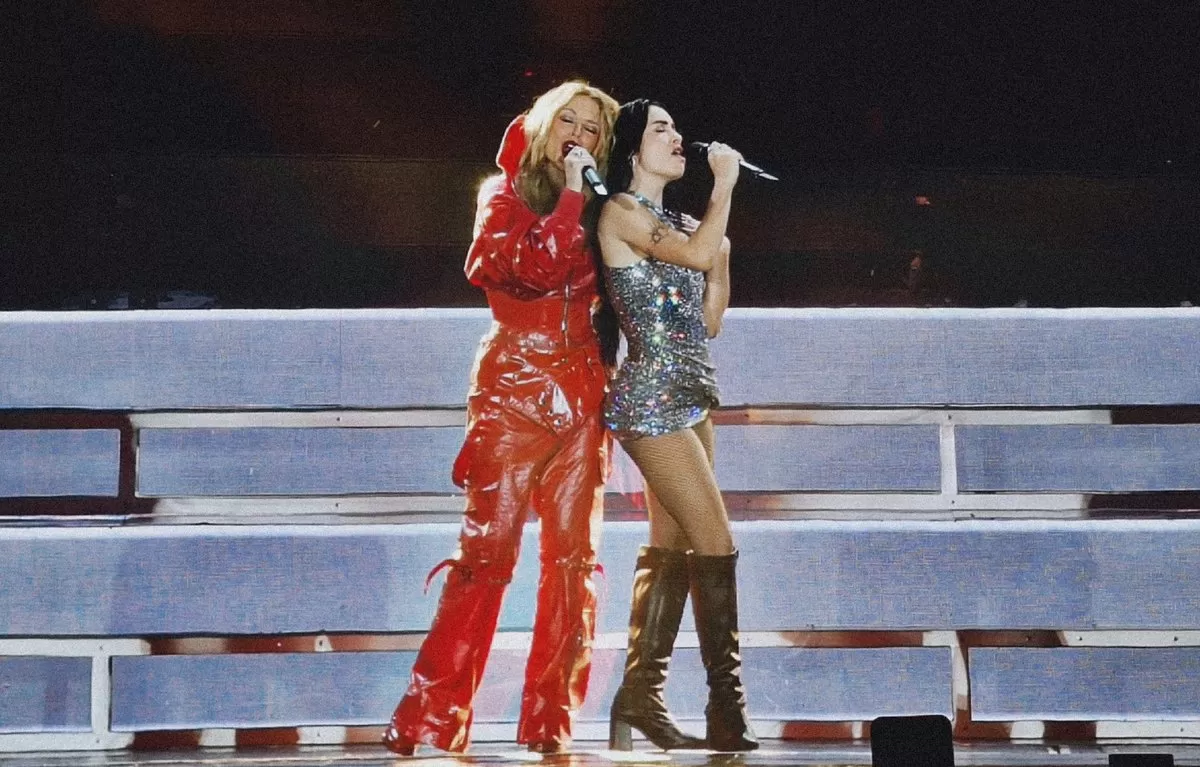

Kylie Minogue’s surprise appearance at Lali’s River Plate concert was more than a viral pop moment: it may have been the beginning of a new international chapter for Argentina’s biggest pop star.
When Kylie Minogue appeared unexpectedly on stage with Lali in Buenos Aires, the image instantly travelled far beyond Argentina. It was not just the surprise of seeing one of pop’s most enduring global icons joining a Latin American star in front of a euphoric stadium audience. It was the feeling that something more strategic, emotional and potentially historic was happening in real time.
For many international audiences, Lali Espósito is still a name waiting to be discovered. In Argentina, however, she is one of the country’s defining pop figures: actress, singer, performer, LGBTQIA+ ally and a woman who has turned public scrutiny into artistic power. Her River Plate concerts were already a statement of scale. With Kylie by her side, they became a possible gateway to the global market.
Why did Kylie Minogue choose Lali?
The question now is unavoidable: why would Kylie Minogue, an artist often compared with figures such as Madonna and Britney Spears, and repeatedly described as one of the queens of pop, choose to share such a visible moment with a singer who remains relatively unknown outside the Spanish-speaking world?
Perhaps because Kylie saw something familiar in Lali.
Before becoming an international symbol of reinvention, glamour and dance-floor freedom, Kylie Minogue was underestimated. Her early career was often dismissed by parts of the media with the kind of condescension frequently directed at young women who move from television into music. Her voice, credibility and artistic control were questioned before time proved her resilience. What some once used against her eventually became her greatest strength: the ability to evolve without losing emotional connection with the public.
Lali has lived a similar story in Argentina. She also moved from acting into pop and had to fight the idea that a young television star could not become a serious artist. Her talent, live performances and ambition were questioned before they were recognised. Like Kylie, she built credibility through consistency: albums, choreography, acting roles, touring, reinvention and a fanbase that followed her growth step by step.
Their connection also runs through one of pop’s most powerful cultural spaces: the LGBTQIA+ community. Kylie has long been embraced as a queer icon, not because of a calculated marketing strategy, but because her music has become part of club culture, Pride celebrations and the emotional memory of generations. Her songs have offered escape, joy and freedom to audiences who found in pop something more intimate than entertainment.
Lali, in her own context, has also been closely linked to LGBTQIA+ visibility, feminism and progressive causes in Argentina. That position has not come without consequences. Her public voice, together with her centre-left political sensibility, has made her a target of criticism, online attacks and conservative backlash in her home country. In recent years, she has become more than a pop star: she has become a cultural symbol in a politically divided Argentina.
That may explain why the meeting between Kylie Minogue and Lali felt so meaningful. Kylie did not simply choose a singer for a surprise appearance. She chose an artist whose journey mirrors some of her own battles: the dismissal, the media noise, the questioning of female pop credibility and the pressure of becoming a public symbol beyond music.
At River Plate, that connection became visible. Kylie did not appear as a distant legend arriving to bless a local artist. She entered Lali’s world with warmth and complicity. The performance of ‘Can’t Get You Out of My Head’ and ‘Padam Padam’ worked because it felt natural: two pop performers who understand spectacle, community and the emotional power of a chorus shared by thousands.
Could Kylie Minogue and Lali release a song together?
For Lali, the moment could become a turning point. Latin pop has already proved that language is no longer an obstacle when an artist has a strong identity. But Lali’s possible international breakthrough would not need to follow the old crossover formula. She does not have to erase her Argentine identity to become global. She only needs the right bridge — and Kylie Minogue may have just offered one.
Of course, the biggest question remains open: are Kylie Minogue and Lali preparing a musical collaboration?
The rumours are already circulating, and the idea makes sense. A joint single would connect Kylie’s current dance-pop renaissance with the Latin market, while giving Lali a powerful introduction to audiences beyond Argentina and Spain. For Kylie, it would be a smart and emotionally coherent move. For Lali, it could be the international push that transforms regional devotion into global recognition.
Still, this should not be read as Lali being rescued by a global star. The story is more interesting than that. It looks like a generational exchange between two women who understand that pop is often dismissed until it becomes undeniable.
Maybe Kylie saw in Lali a younger artist who knows how to survive prejudice, political noise and public scrutiny without losing the joy of performance. Maybe she recognised a singer who understands that pop is not only about charts, but about community. Maybe she saw someone who, like her, has been forced to prove that glitter can have substance.
Whatever comes next, the image of Kylie Minogue and Lali together in Buenos Aires already feels bigger than a surprise cameo. It feels like the beginning of a new pop alliance. And if Lali is ready to step beyond the Spanish-speaking world, she could hardly ask for a more powerful godmother than Kylie.