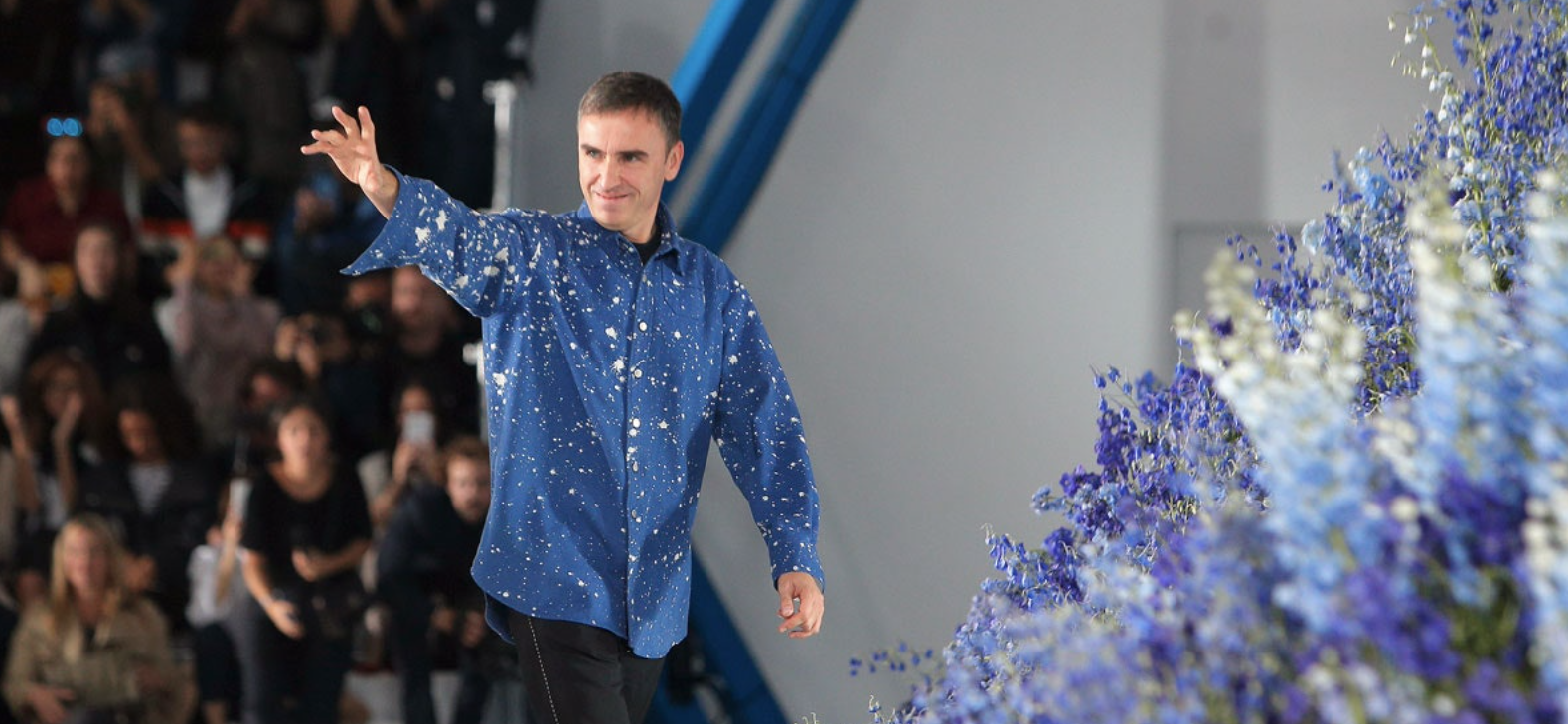

Renowned Belgian designer Raf Simons, who served as creative director at Dior from 2012 to 2015, has made his mark in a book that explores the French fashion house and highlights the creations through which he brought “a contemporary approach to the founder’s legacy.”
“Dior by Raf Simons” (Ed. Assouline) is the sixth publication by the editorial dedicated to each of the haute couture designers of the French fashion house. This time, fashion journalist Tim Blanks, from “The Business of Fashion,” provides a detailed analysis of this period, accompanied by 225 images captured by Laziz Hamani.
In 2012, Dior turned to the vision of Belgian designer Raf Simons to redirect the haute couture house following John Galliano’s sudden departure due to his controversial racist and anti-Semitic remarks. The brand not only sought to overcome this setback but also captivate its loyal customers, and Simons became its savior by revitalizing the collections of all the lines.
“Simons brought a contemporary touch to Dior’s romantic legacy, blending his sleek aesthetic with Dior’s poetic femininity,” notes Blanks in the book.
During his time at Dior, he garnered the devotion of personalities such as Lupita Nyong’o, Rihanna, and Emma Stone, while Jennifer Lawrence, remembered for her memorable fall at the Oscars in one of Simons’ designs, as well as Natalie Portman and Jessica Biel, became prominent figures for the brand.
The book showcases the convergence between the heritage passed down by Christian Dior and the reinvention of the house through contemporary proposals. These two worlds merged, as both designers shared a passion for architecture, art, and gardens.
Since his first show for the brand, Simons made it clear that he intended to pay homage to Dior’s history through the iconic “Bar” jacket, adapting it to the present in the form of dresses with distinct cuts while retaining its emblematic structure: defined waist and upright chest. In this way, he conferred renewed and unique value to his designs.
During his tenure, Simons decided to revive one of Dior’s iconic elements: the leopard print that the historical founder first used in 1947 as an alternative to real fur of the time.
However, after three and a half years, Raf Simons announced his departure as creative director due to “personal reasons,” with the intention of focusing on “other interests in my life.” Among these was his dedication to his own brand, and he recalled having lived “one of the most significant experiences” of his professional career at Dior.