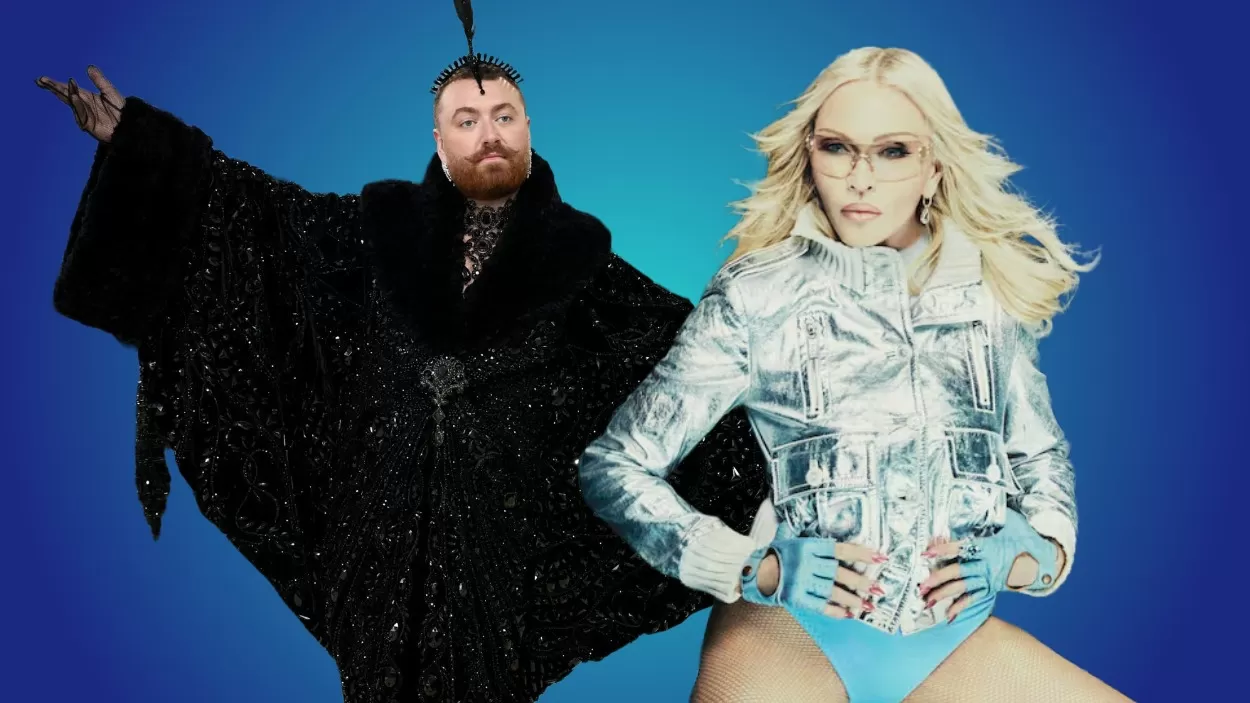

Sam Smith reflects on Madonna’s support during the ‘Unholy’ backlash and explains why the pop icon remains an inspiration to them.
Sam Smith has opened up about the crucial support they received from Madonna during one of the most controversial periods of their career. The British singer has reflected on the intense reaction surrounding “Unholy”, their global hit with Kim Petras, and revealed how the Queen of Pop made a point of reaching out when criticism intensified.
Speaking on Apple Music’s The Zane Lowe Show, the 34-year-old Grammy and Oscar winner described the relationship with extraordinary affection. “Madonna is my mother,” Smith said, before adding: “She’s just unf–kingreal.”
The connection became particularly meaningful following the success of “Unholy”, released in 2022. The track became one of the defining songs of Smith’s career and ultimately earned Sam Smith and Kim Petras a Grammy Award, but its provocative imagery and performances also triggered considerable controversy.
According to Smith, Madonna immediately understood what they were experiencing. “The minute it happened, she made sure she got through to me,” they explained. For the singer, that gesture carried additional significance because Madonna’s music had already represented something much bigger throughout their life.
Smith described her work as “a lifeline”, particularly for LGBTQ+ audiences, highlighting the long relationship between Madonna’s career and queer culture. “You feel that in her music,” they said.
That solidarity became highly visible at the 2023 Grammy Awards, when Madonna personally introduced Smith and Petras before their performance of “Unholy”. Rather than avoiding the controversy surrounding the artists, she addressed the subject directly.
“I’m here to give thanks to all the rebels out there forging a new path and taking the heat for all of it,” Madonna told the audience. She continued by recognising those willing to challenge expectations: “You are seen, you are heard; and most of all, you are appreciated.”
Madonna then introduced Smith and Petras as “two incredibly talented artists who have risen above the noise, the doubt, the critics; into something beautifully unholy.”
The subsequent Grammy performance of “Unholy” became one of the ceremony’s most discussed moments. Smith and Petras appeared in red costumes, with Smith wearing devil horns as part of a theatrical staging built around provocative religious imagery.
The performance attracted criticism from conservative commentators, some of whom characterised the staging as demonic or evil. The reaction did not remain confined to debates about artistic expression. In the days following the Grammys, Smith was subjected to homophobic and transphobic verbal abuse, demonstrating how quickly criticism surrounding a performance could become personal.
Madonna’s support continued beyond that evening. Several months later, she invited Smith to collaborate on “Vulgar”, released in June 2023 around Pride season. The track united two artists who have repeatedly used pop music to explore sexuality, identity and freedom while refusing to retreat in response to controversy.
For Smith, Madonna’s awareness of what happens within the LGBTQ+ community remains one of the qualities that makes her influence particularly important.
“She’s so aware of queer news and what’s happening in the community, to the artists within the community,” Smith explained.
Their admiration also extends to Madonna’s longevity. Across more than four decades, the singer has repeatedly faced disputes surrounding sexuality, religion, gender expectations and artistic freedom while continuing to reinvent her music and image.
“Her music is a lifeline to queer people,” Smith said, praising “all of the eras of her and her stamina and how she’s just always carried on and on and on.”
For Smith, that resilience offers a powerful example of how an artist can survive changing cultural climates without abandoning the principles that shaped their work.
“I just find it very inspiring,” they concluded.