
New documents reignite debate over Jeffrey Epstein’s profile in Vanity Fair and the editorial decisions that left out key testimonies.
For years, the name Jeffrey Epstein has been associated with power, impunity and networks of influence. Yet the spotlight does not fall solely on the financier. It also falls on the press. Fresh testimonies and documents have revived an uncomfortable question: why did one of the world’s most influential magazines publish a favourable profile of him when serious allegations were already circulating?
In the early 2000s, journalist Vicky Ward was investigating Epstein for a feature in Vanity Fair. During her reporting, she spoke with Maria Farmer and Annie Farmer, two of the earliest complainants, who described sexual abuse that had allegedly taken place years earlier. According to their accounts, the assaults occurred in the 1990s and also involved Ghislaine Maxwell, who was later convicted of sex trafficking.
The issue was not the investigation itself. It was what followed.
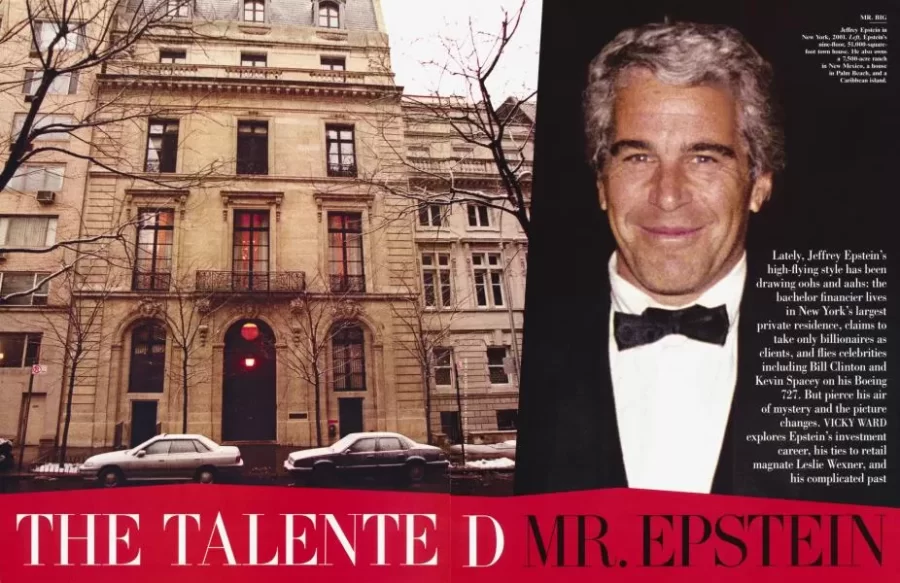
The profile was published in 2003 under the title “The Talented Mr. Epstein” (it remains available online). However, the Farmer sisters’ allegations were removed from the final version. They were neither softened nor countered — they simply did not appear.
Shortly before publication, Epstein himself went to the offices of the magazine’s then editor-in-chief, Graydon Carter. Internal emails from the newsroom reportedly expressed surprise at his presence. Ward later stated that the businessman was furious upon learning the content of her investigation and denied the accusations.
Years later, Carter acknowledged that Epstein had come to the magazine’s headquarters, although he maintained that they did not meet in his office. Ward, for her part, consistently defended that her sources had been verified and documented.
Here lies the crucial point.
According to Carter’s later statements, the publication’s legal team considered the testimony insufficiently robust to defend in court. In other words, it was not deemed false — it was deemed legally risky. The editorial consequence was to remove the allegations and reshape the piece into a society portrait of the billionaire.
With historical hindsight, that decision appears pivotal. Years later, federal investigations confirmed that Epstein had abused minors. The complainants, who had not been included in the article, were ultimately vindicated.
The controversy extends beyond Epstein himself and touches the mechanics of the media system. Major magazines do not operate in a vacuum: they rely on social relationships, access to powerful sources and careful legal calculations. Publishing allegations against a billionaire with the means to litigate can entail years of costly legal battles.
Some journalists have argued that the issue was not necessarily a conspiracy, but a more familiar phenomenon: pre-emptive self-censorship. The fear of defamation lawsuits — particularly in the United States — often leads media outlets to demand near-judicial levels of proof before publishing serious accusations.
The practical outcome, however, was clear: one of the earliest opportunities to publicly expose Epstein’s behaviour was lost.
In retrospect, the case reveals an enduring tension in contemporary journalism. The press acts as a counterweight to power, yet it is also an institution vulnerable to economic, social and legal pressure — especially when the subject belongs to the financial elite and maintains relationships with influential figures.
Today, the debate is not merely historical. It is structural: what happens when a potentially true story cannot be published because the legal risk outweighs the protection of victims?
The Vanity Fair episode has become a case study in journalism schools and media analysis — not as proof of direct complicity, but as a cautionary example: silence, too, carries informational consequences.
Epstein’s crimes eventually came to light through subsequent journalistic and judicial investigations. Yet the episode leaves the profession with an uncomfortable reminder: journalism is measured not only by what it publishes, but also by what it chooses not to publish.
It compels a broader question about trust. If financial power can delay or mute scrutiny, what safeguards truly protect the public interest? In that space — between legal prudence and public responsibility — some of the most consequential truths are either built or lost.