The Fall–Winter 2026 collection by ZEGNA rethinks menswear luxury through memory and everyday use, placing the family closet at the emotional and creative core of the proposal.
For ZEGNA, the wardrobe is not a transient space but a living one, where garments rest, age and return to the body time and again. Built on this premise, the Fall–Winter 2026 collection revolves around the idea of a family closet — a shared wardrobe that connects generations through the daily act of dressing. Clothes are not preserved as relics here; they are worn, inherited and continually reinterpreted.
The collection is born from a real, intimate wardrobe comprising garments belonging to Gildo Zegna and Paolo Zegna, representatives of the family’s third generation. These sit alongside pieces passed down from earlier generations, acting as living references that shape proportions, fabrics and forms. At the symbolic centre stands the legendary ABITO N.1, the first suit made in the 1930s for Ermenegildo Zegna, crafted Su Misura in Australian wool and displayed in a glass case — not as a museum piece, but as the emotional anchor of the narrative.

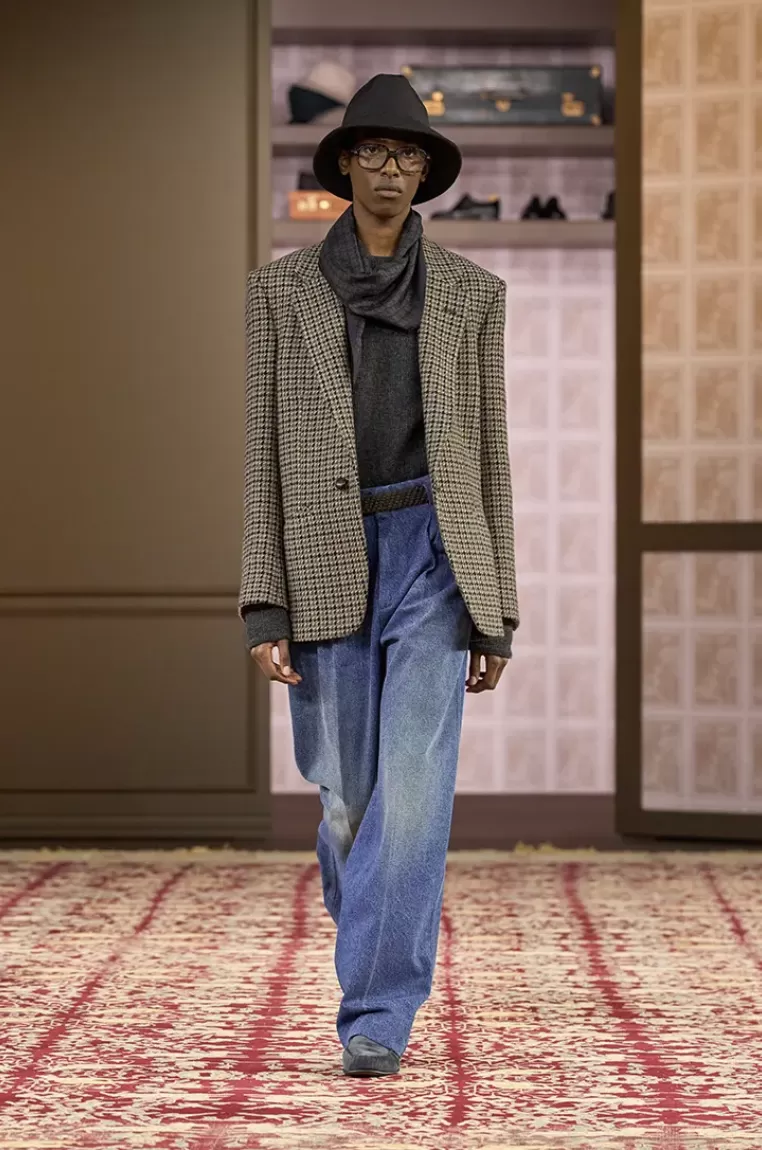


Artistic Director Alessandro Sartori conceives fashion as a second skin built over time. In his vision, garments move from one body to another within a shared wardrobe, protected from neglect so they remain useful. The moment of discovering a jacket once worn by a father or grandfather becomes the creative engine: a quiet dialogue between posture, attitude and memory. The result is clothing designed to endure, not to be exhausted in a single season.
The house’s historic Trofeo wool, introduced in 1965, plays a central role and is reinterpreted through a contemporary lens. Each garment is developed through constant testing — wearing, adjusting, wearing again — allowing the body and real use to ultimately define the design.
In silhouette, coats and jackets gain length and volume, with defined shoulders and structural presence. Trousers flow from high, cinched waists, while the double-breasted jacket evolves: some versions reduce the closure to a third of its usual structure; others introduce an additional horizontal button that allows multiple fastening options and adaptable fits. Flexibility is key. Blazers with double lapels, blousons with double collars and fluid categories appear without rigidity.
Materials bring warmth and texture. Shearling, knitted bombers and graphic leather pieces coexist in stand-collar blazers, quilted gilets and jackets. Accessories extend the lived-in wardrobe logic: slippers and moccasins in suede, wool felt and nubuck; squared-frame glasses; felt-lined rain hats; and softly structured bags designed for everyday use.
The colour palette moves from creamy tones such as stella alpina, meliga and larice into deeper shades of mogano, brandy, terra, corteccia, torba and bosco. Accents of zaffiro, bruma and giada add contrast, while anthracite grey and softened black reference the classic origins of menswear tailoring. Fabrics — tweed, flannel, denim, gabardine and cashmere variations — are chosen for weight, texture and their ability to age with dignity.
With Fall–Winter 2026, ZEGNA proposes a vision of luxury rooted in continuity, use and inheritance. A collection that does not seek to impose itself, but to accompany. Because in this family wardrobe, dressing well is not about novelty — it is about shared history.