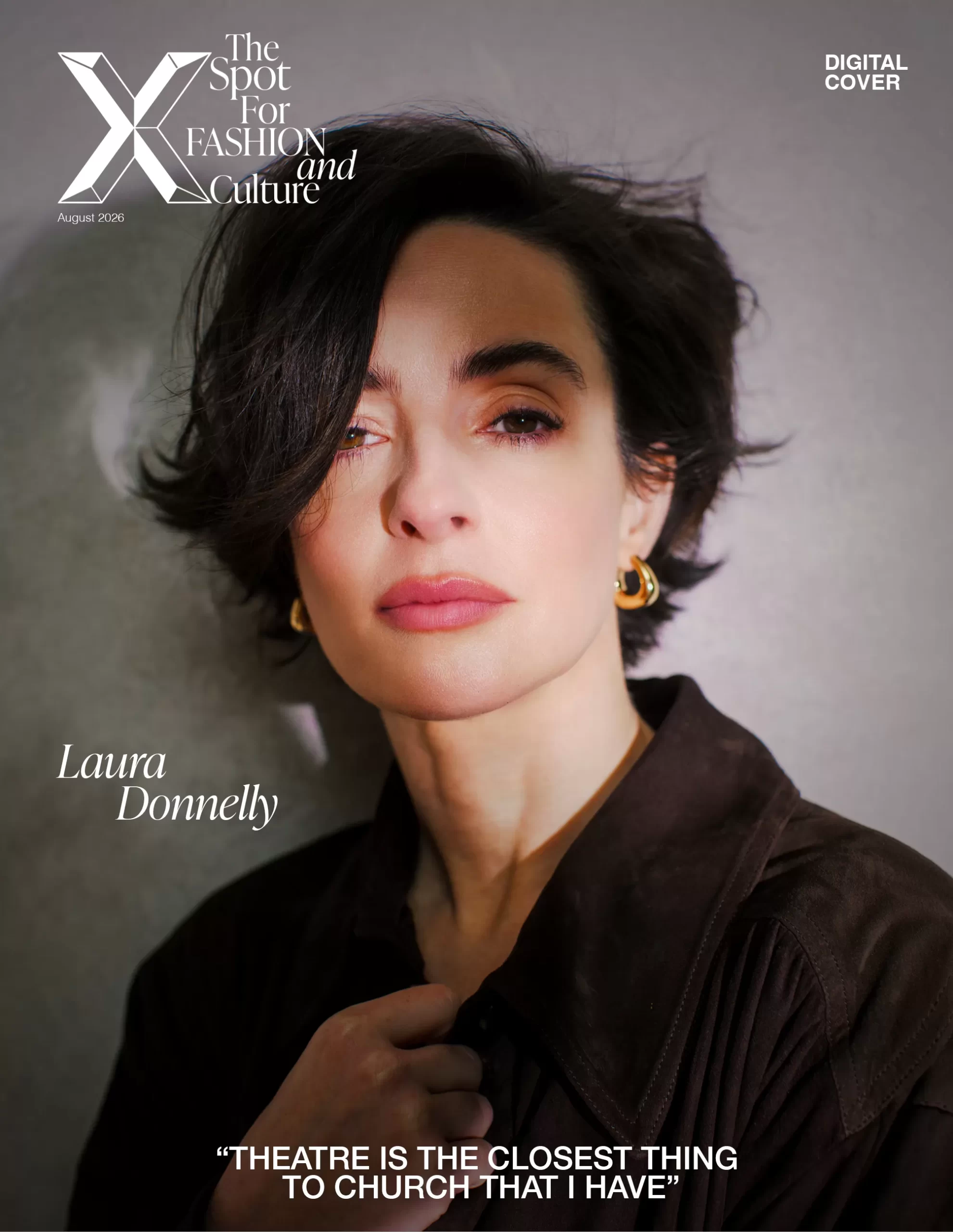

The Belfast-born actress reflects on film noir, complex women, real-life figures and the creative freedom of the stage.
For Laura Donnelly, acting has always been connected to storytelling in its oldest and most instinctive form. Her first experiences on stage came through a dance company performing Irish myths and legends. Her roots may not shape every character she plays, but they remain inseparable from the reason she became an actress.
“Something about telling those stories satisfied something deep in my bones,” she says. “It connected me with my roots, with the mythology of the country and with the importance Ireland has always placed on storytelling.” That influence becomes especially clear when she takes on an Irish role, but it also remains present in her wider commitment to performance.
Entering the film noir world of ‘Sugar’
In the second series of ‘Sugar’, Donnelly plays Charlotte, a mysterious figure entering the already distinctive world of the Apple TV+ drama. The opportunity to work opposite Colin Farrell was one of the project’s immediate attractions. She had admired his work for years, while filming in Los Angeles offered her the chance to work in a city she had long loved but had never previously filmed in.
What ultimately made Charlotte exciting was the opportunity to play within the language of film noir. The character carries traces of the classic femme fatale in the way she moves, speaks and presents herself, as well as in the glamour associated with Old Hollywood. The challenge was to draw on those influences without reducing her to an imitation.
“I wanted to bring out as much of that world as possible,” the actress explains, “but still make her feel modern and ensure that she never became a pastiche.”
Having watched the first series, she already understood the production’s distinctive tone. That familiarity allowed certain elements of Charlotte’s personality and physicality to emerge instinctively, particularly the way she speaks, moves and brings a subtle femme fatale energy into the story.
Her working relationship with Farrell also developed at much the same pace as the connection between Charlotte and John Sugar. As the characters meet for the first time at the beginning of the series, the two actors were able to discover their dynamic naturally as filming progressed.
-scaled.webp)
During the first few episodes, they shared relatively few scenes, meaning their off-screen relationship developed gradually alongside the story. Rather than having to manufacture the familiarity of two characters with an established history, they were able to let the connection grow in real time.
Finding the human reality within the darkness
Shortly afterwards, Donnelly leads ‘The Dark’, an intense crime story set in the Scottish Highlands. As Monica Kennedy, she enters a world shaped by disturbing crimes, but her preparation did not begin with the darkness of the plot. Instead, she focused on everything that had brought the character to the point at which the audience first meets her: her relationship with her mother and daughter, her work and the uncertainty that has replaced her previously reliable trust in her own instincts.
The role was built around recognisable experiences such as regret, responsibility, motherhood and the loss of self-belief. “The crimes carry their own darkness,” she says. “I focused on the everyday human aspects of Monica so that, when the more extraordinary events of the story reached her, I was able to respond instinctively through the character.”
That approach reflects what the performer looks for in female characters more generally.
She is less interested in visible strength than in what a person is concealing, suppressing or failing to understand about herself. For Donnelly, the most intriguing qualities are often those that exist beneath the surface and reveal themselves without the character being entirely conscious of them.
“Women the world over are strong,” she says. “When we are presented with challenges, we find a way through them. The question for me is whether there is strength in the writing.”
What matters is whether a character contains the contradictions of a real person: the qualities she displays, the things she hides and the parts of herself she may not recognise. Rather than playing women defined by a single characteristic, the actress wants to portray people who feel as multifaceted and unpredictable as possible.
Portraying Rose Kennedy from the inside
That commitment to complexity is central to ‘Kennedy’, the Netflix production in which she plays Rose Kennedy opposite Michael Fassbender. Taking on such an iconic real-life figure carries an obvious weight of expectation, but Donnelly views her responsibility as something deeply personal.
“The responsibility I feel is towards her,” she says. “In a way, that is between me and Rose.”
Research can provide books, interviews, photographs and personal recollections, but no single account can offer a definitive version of another human being. Different people encounter different sides of the same person, and there are still people alive whose memories of Rose Kennedy will inevitably differ.
Her aim was therefore not to create a perfect impersonation or claim to have found the only accurate interpretation of her. Instead, she wanted to capture something of Rose’s essence: her bravery, dignity and, above all, her integrity.
“Her spirit was as solid as a rock,” she says. “The word that comes to mind most strongly is integrity.”
-scaled.webp)
Costume and public image became essential tools in accessing that inner life. Working closely with costume designer Jane Petrie, as well as the hair and make-up departments, the actress explored how Rose’s clothes expressed her taste, ambition, strength and composure. Having previously worked with Petrie, she was able to build upon an existing creative relationship throughout the process.
Every look prompted a discussion about what Rose was experiencing privately and what she wanted to present to the outside world. Her elegance was not merely decorative; it became part of the way she maintained control and carried herself through difficult circumstances. Her clothes often reflected her dignity, determination and awareness of how she would be perceived.
“Theatre is the closest thing to church that I have”
Despite her extensive screen career, theatre continues to offer Donnelly something she cannot find elsewhere. Repetition allows a character’s experiences to settle more deeply into the body. In film or television, an actor may reach a particular emotional place for a scene, complete it and then leave it behind. On stage, the journey is repeated night after night, changing subtly each time and remaining with the performer long afterwards.
Characters played in the theatre often become a more deeply lived experience. They continue developing throughout the run and can alter the actor in ways that are less common when filming scenes out of order and only once.
The presence of a live audience makes that experience even more profound. “Everyone in the room is creating something together,” she says. “The audience is as much a part of the performance as the actors and the crew backstage. It is the closest thing to church that I have.”
For her, theatre creates a temporary community in which people gather to explore, consider and reflect upon what it means to be human. The shared experience between the performers and the audience creates a form of connection that she does not find as readily in television or film.
Her confidence on stage has also been strengthened through repeated collaborations with playwright Jez Butterworth and director Sam Mendes, including ‘The Ferryman’ and ‘The Hills of California’. Butterworth’s writing, she explains, carries actors naturally towards the emotional destination of a scene, removing the need for the kind of mental gymnastics that can sometimes be required with other material.
Mendes, meanwhile, gives her the confidence to take risks because she trusts his instincts for storytelling and his ability to guide both individual performers and an entire company. He understands how to communicate differently with each actor and how to calibrate every element so that the story lands as intended.
“I know I am in the safest hands humanly possible,” she says. “That allows me to go big and not worry that something will head in the wrong direction, because I trust him to put it all together.”
-scaled.webp)
“There is only the now”
Looking at a career that includes ‘Outlander’, ‘The Nevers’, ‘Say Nothing’, ‘Sugar’ and ‘Kennedy’, it would be easy to describe this as a transformative period. The Belfast-born actress, however, has learned not to think about her career in those terms. She chooses each project for its immediate possibilities: the challenge it presents, the skills it may require or the opportunity to work with someone she has long admired.
The outcome remains beyond her control. Projects expected to change everything can be disrupted by unforeseen circumstances, while a small production can quietly redirect an entire career. She points to a play at the Almeida Theatre in 2011, seen by director Ian Rickson, as one of those apparently modest events that later opened unexpected doors.
“You can never tell what will change things,” she says. “I don’t worry about what happens after my job is done. I’m in it for the thing itself. As far as I’m concerned, there is no future with this stuff; there is only the now.”
She also sees progress in the visibility of women, particularly those over the age of 35, and finds inspiration in actresses such as Meryl Streep, Helen Mirren, Judi Dench, Frances McDormand and Cate Blanchett. When she attended drama school, she assumed that her career might effectively be over by the age of 35 or 40 because that was what the industry appeared to suggest. Seeing women now take on some of their greatest roles later in life has given her greater hope for the future.
Yet representation remains far from equal, not only for women but also in relation to race, disability, sexuality and other lived experiences. Stories shape what people imagine to be possible, and seeing oneself represented can alter the course of a young person’s life and contribute to broader social change.
The same conviction informs her concerns about the future of the arts in the wake of Brexit, which she believes has reduced freedom of movement and made creative collaboration more difficult. As an Irish actress, she has witnessed the extraordinary growth of the film and television industries in Ireland, particularly in the North, and hopes its unique connection to both the United Kingdom and Europe will continue to create opportunities.
For the performer, the answer is to resist treating culture as an optional extra. “The arts are often placed after the supposedly necessary things in society,” she says. “But I believe they are completely necessary to a society in which people are happy, thriving and fulfilled. They are not a luxury. They are essential to our existence.”